
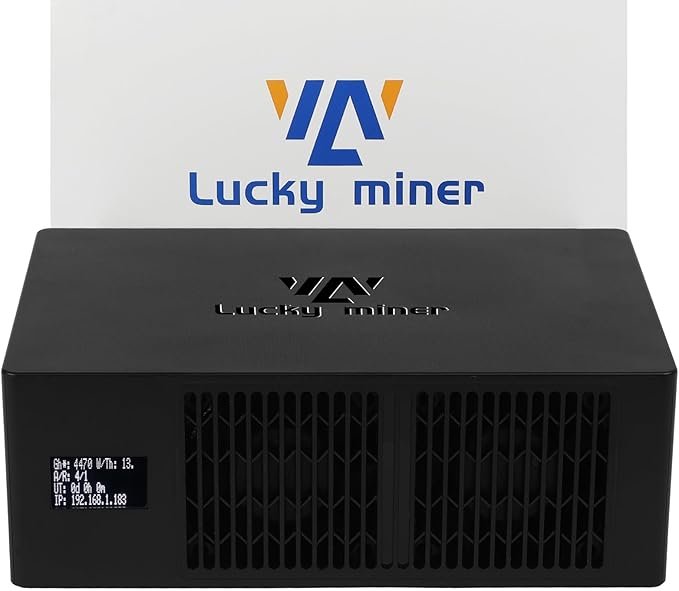
Getting into Bitcoin mining at home can feel like a maze: loud machines, scary power bills, complex setup, and the big one—uncertain payouts. That’s why “one-shot miners” (aka solo/lottery miners) have become a thing. They’re small, quiet devices you can run in a bedroom or office that take a swing at solving a Bitcoin block on their own. The odds are tiny, but the upside is huge if lightning strikes. If that sounds like your vibe—educational, fun, and maybe a moonshot—there’s a slick little option that stands out for home use: a compact SHA-256 unit built around Bitmain’s BM1366 chip with 3.5–4.2TH/s, WiFi, and a “micro silent” footprint designed for solo mining.
1) Build Quality
The appeal here is simple: a portable, home-friendly miner that doesn’t dominate your space or your soundscape. “Micro silent” is the promise, and that’s what you want in a living room or home office. The compact form factor makes placement easy—on a shelf, near a router, or tucked beside a workstation—and its light weight means you don’t need a dedicated rack or soundproofing box.
Because it’s intended for solo or “lottery” mining, the device doesn’t rely on the oversized, high-RPM fans found on industrial rigs. That typically translates into much lower acoustic impact at a few feet away. The integrated 2.4G WiFi reduces cable clutter and lets you place the miner where it’s most convenient for airflow rather than where an Ethernet jack happens to be.
The headline component is the BM1366 ASIC—modern, efficient, and compatible with the SHA-256 algorithm Bitcoin uses. While the listing doesn’t spell out enclosure materials or thermal design specifics, the combination of modest hashrate (3.5–4.2TH/s) and home use intent suggests thermal loads are manageable with a simple, quiet cooling solution. For 24/7 uptime, position it where it can breathe—away from soft surfaces or tight cabinets.
2) Key Features & Benefits
- 3.5–4.2TH/s Hashrate: This is the heart of the proposition. It’s nowhere near industrial-class output, but it’s solid for a home “one-shot” unit. You’re getting real ASIC performance, not a novelty board that measures hashrate in megahashes or kilohashes.
- BM1366 ASIC: The BM1366 generation is designed for SHA-256 workloads. That means stability, broad compatibility with common mining software/pools, and proven silicon built for long, continuous runs.
- Solo Miner Mindset: The product is literally branded around “lotto” mining. The idea is you point it at a solo instance or a pool’s solo endpoint and let it run. If you hit a block, you take the whole block subsidy plus transaction fees. That upside is the thrill. The trade-off is the probability is extremely low at this hashrate.
- 2.4G WiFi: Built-in WiFi is a real convenience for home setups. No extra dongles or network runs required. This also makes it easy to move the miner around if you’re optimizing for airflow or experimenting with location.
- SHA-256 Ecosystem Compatibility: While the “lottery” use case is the angle, you can also connect to a traditional mining pool for steady trickle payouts. That flexibility is valuable if you decide to pivot from “moonshot” to “predictable share”.
- Portable, Home-First Design: The listing explicitly calls out “micro silent” and “home use.” If you’ve avoided mining because of noise and bulk, this device removes those two deal-breakers.
3) Real-World Performance / Use Cases
Let’s set expectations. Solo mining with a few terahashes is basically buying a continuous, programmable raffle ticket. With network hashrate in the hundreds of exahashes per second, the probability of a 3.5–4.2TH/s miner solving a block on its own is microscopic at any given moment. Over a long average, your expected time-to-win is measured in many lifetimes. That’s why people call these “lottery miners.”
That doesn’t make them pointless—just different:
- Education: They’re fantastic teaching tools. You’ll configure a miner, connect it to WiFi, see hashes roll, monitor shares, and understand the flow from nonce search to pool submission (even in solo mode).
- Home/Office Friendly: The “micro silent” angle makes it reasonable to run 24/7 without disrupting other work or sleep.
- Occasional Pool Mode: If you want earnings you can actually chart, switch to a reputable pool and collect proportional rewards. You’re trading the remote possibility of a jackpot for predictable small payouts.
- Community Projects: Some folks join pool lotteries with friends or run dashboards to track uptime and hashrate, turning it into a hobby rather than a strict ROI machine.
A quick reality check on odds (approximate, not a guarantee): if the network is on the order of hundreds of exahashes per second, your 4TH/s slice is on the order of one-in-tens-of-millions chance per block. There are about 144 blocks a day. That’s the reason these are called “one-shot” miners—each day is another series of shots on goal, but the goal is very small and very far away.
That said, the experience is low-friction. WiFi setup beats dragging cables across the floor. SHA-256 compatibility means standard software and pool endpoints. And the small footprint means you don’t suddenly become the steward of a rack, ducting, or dedicated circuits. If you’ve ever wanted to show a class or a kid what ASIC mining looks like without turning the room into a jetway, this is exactly the right scale.
4) Drawbacks & Limitations
- Probability vs Payback: The biggest drawback is baked into the concept. A “lottery” miner won’t deliver steady yields by itself. If you want predictable payouts, point it to a pool and accept smaller, share-based returns.
- Efficiency Data Gap: The listing doesn’t publish a power draw or joules-per-terahash figure. Without that, you can’t compare operating cost per terahash against other home-focused miners with known specs. That makes budgeting a guess until you measure it at the wall.
- 2.4G WiFi Only: Many homes are crowded RF environments (smart devices, microwaves, neighboring routers). 2.4G can be noisy compared to Ethernet or 5G/6G WiFi. If your network is flaky, consider placing the miner close to the router or using a dedicated 2.4G SSID.
- Limited Expandability: This is intentionally a small, single-board form factor. You’re not going to scale this into a high-throughput farm; it’s a compact, low-profile device. If you plan to grow into multiple units, think about power strips, airflow, and cumulative heat.
- Solo UX Expectations: With minimalistic devices, the management interface can be bare-bones. The basics should be there (SSID, password, mining endpoint, worker), but don’t expect enterprise-grade remote management unless the vendor provides it.
Mini-Comparison
- Magic BG02 Home Bitcoin Miner (7TH/s, about 150W, ~40 dB): If you want a bit more oomph while staying home-friendly, the BG02 roughly doubles the hashrate of the “lotto” unit here at an efficiency around 21.4J/TH. It’s still quiet for a miner and compact enough for a desk or shelf. For pool mining, that extra 3TH/s translates into more predictable daily shares without jumping to datacenter noise levels.
- Nerdqaxe++ Hydro (4.8TH/s, ~75W, hydro cooling): This one emphasizes efficiency and silence. Its hydro cooling keeps noise extremely low, and ~4.8TH/s at ~75W is impressively frugal. If your top priority is a near-silent experience with excellent watts-per-TH, it’s a strong alternative, and it still aligns with the “one-shot” ethos for solo mining.
- NerdMiner V2 (≈960KH/s): A true “lottery” gadget. It sips power and is very affordable, but its hashrate is orders of magnitude lower than even a 3.5–4.2TH/s unit. Great as an educational display and conversation piece; not realistic for pool payouts and even more lottery-like for solo.
FAQ
Q: What does “one-shot” or “lottery” mining actually mean?
A: It means solo mining: you point your miner at a solo endpoint and try to find a valid block yourself. If you succeed, you get the entire block reward and fees. If you don’t, you get nothing for that time. It’s a bit like keeping a raffle ticket running 24/7.
Q: Can I use this miner with a pool instead of solo?
A: Yes. It supports SHA-256, so you can connect to standard Bitcoin mining pools. In pool mode, you’ll earn small, proportional payouts based on your contributed hashrate rather than an all-or-nothing block find.
Q: How loud is it?
A: The product emphasizes “micro silent,” which signals a quiet acoustic profile compared to industrial rigs. Noise still depends on placement and ambient temperature, so give it open airflow and avoid enclosed cabinets.
Q: Is WiFi reliable enough for mining?
A: Generally, yes—mining traffic is light. But 2.4G can be crowded, so place the miner close to your router or use a dedicated SSID if you see disconnects. If your environment is noisy, consider a model with Ethernet or a strong 2.4G setup.
Q: How do I estimate profitability?
A: You’ll need hashrate, power draw, electricity cost, and pool data (if using one). The listing doesn’t publish a power figure, so measure at the wall with a power meter. For solo mining, profitability models don’t apply in the usual sense—it’s about probability, not steady income.
Verdict
If you want to try Bitcoin mining at home without turning your space into a server room, this “micro silent” 3.5–4.2TH/s SHA-256 unit nails the brief. It’s compact, flexible (solo or pool), and designed for everyday living spaces. As a “one-shot” miner, it shines for education and for folks who love the idea of a background lottery ticket humming away.
If your goal is predictable daily earnings, point it to a pool—or consider stepping up to something like the Magic BG02 for more hashrate or the Nerdqaxe++ Hydro for standout efficiency and near-silent cooling. But if you’re here for the fun, the tinkering, and the (minuscule) chance of a solo block, this is a friendly, home-ready way to join the party without the roar of an industrial rig.
I’d recommend it to:
- Curious builders and educators who want a tangible, quiet ASIC example.
- Bitcoin believers who like the lottery-miner ethos and don’t expect steady payouts.
- Home users seeking a low-footprint, WiFi-enabled miner they can run unobtrusively.
As long as you embrace the “jackpot or nothing” nature of solo mining (and set your expectations accordingly), this compact miner is an easy, enjoyable on-ramp into the world of SHA-256 mining.





Leave A Comment